

https://aseanmp.org/publications/post/aseans-myanmar-paralysis-continues...
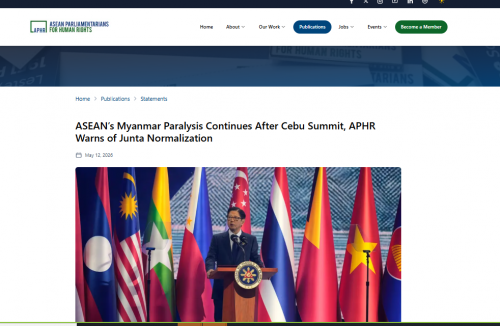
In the post-Summit press conference, Philippine President Ferdinand Marcos Jr. expressed frustration over the lack of progress and the absence of consensus among member states, describing the situation as a “thorny problem” with no clear solutions and the 5PC implementation as “moribund.”
The Chair’s Statement on Myanmar reflects the bloc’s familiar pattern of expression concern without concrete actions. It produced no new accountability mechanisms, no formal engagement with the National Unity Government (NUG) and ethnic resistance organizations, and no independent ceasefire monitoring provisions. These are limitations that APHR and civil society groups have flagged as reducing the ceasefire language to “an ambiguous gesture” allowing the junta to exploit the rhetoric while continuing its violence with impunity.
ASEAN’s consensus and non-interference principles remain the bloc’s biggest self-imposed hurdle. Thailand, Cambodia, and Laos bear particular responsibility for blocking more decisive collective action. While Myanmar remains excluded from high-level meetings, recent overtures by Thai Foreign Minister Sihasak Phuangketkeow and the proposed virtual meetings with Myanmar’s foreign ministers signals what APHR warns as gradual normalization of the military regime. In April, the Philippines also expressed sustained engagement with the junta leaders.
“The junta regime led by Min Aung Hlaing has no claim to political legitimacy,” said Mercy Chriesty Barends, Member of Indonesia House of Representatives and Chairperson of APHR. “ASEAN cannot rely on the junta, who has no intention of halting violence or implementing the 5PC, to lead its own people towards peace and stability.”
While humanitarian assistance through the AHA Centre was mentioned, the ASEAN fails to address aid obstruction and restrictions on humanitarian access, and reliance on military-controlled structures that block basic supplies from reaching conflict areas. The statement also acknowledged the link between the Myanmar crisis and transnational crime, including scam operations, human trafficking, forced labor, illicit finance, that harm ASEAN citizens.
“The crisis in Myanmar was never a domestic issue only,” said Wong Chen, Member of Parliament for Suba, Malaysia and Board Member of APHR. “ASEAN cannot insist on a Myanmar-led transition to democracy without holding Min Aung Hlaing and the junta accountable first.”
Five years after the coup, communities in Myanmar continue to face airstrikes, bombings, and repression while ASEAN remains paralyzed, not merely by competing interests but by a consensus rule that effectively grants veto power to the junta’s most accommodating neighbors.
APHR calls on ASEAN to recognize Myanmar’s democratic representatives as legitimate partners; establish clear benchmarks and consequences for junta non-compliance with the 5PC; and ensure humanitarian access independent of military-controlled structures. ASEAN must resist pressure from member states to normalize engagement with the junta before accountability conditions are met.
ASEAN’s credibility depends on whether its engagement reflects the democratic aspirations and protection needs of the Myanmar people, not the military’s consolidation of power.
—