

https://www.thegef.org/newsroom/news/gef-council-review-progress-and-con...
Meeting virtually Dec. 15-19, representatives of the Global Environment Facility’s 186 member countries will consider more than $350 million in funding for projects and programs related to improving policy coherence, addressing illegal fishing, sustaining permafrost peatlands, bolstering the resilience of small island states, addressing threats from mercury use, and regenerating farmlands with blended finance.
This will be the second-to-last Council gathering in the $5.3 billion GEF-8 cycle, which runs through June 2026. The proposed funding includes support delivered through the GEF Trust Fund ($291 million); the adaptation funds LDCF ($49 million) and SCCF ($3 million); and the GBFF ($29 million). Together, this family of funds serves six multilateral environmental conventions and supports integrated responses to priorities related to biodiversity, climate change, and pollution, including “forever chemicals,” mercury, and plastics, with a whole-of-society approach that prioritizes Indigenous Peoples and local communities.
In addition to holding sessions with representatives of civil society organizations and with the heads of environmental conventions, Council members will take stock of major progress towards achievement of GEF-8 targets, reflecting an unprecedented record of delivery, scale, and ambition.
Projects and programs approved since July 2022, inclusive of the work program to be considered by Council in December 2025, are set to generate wide benefits including:
- protecting 222 million hectares of terrestrial and marine protected areas
- improving the management of 906 million hectares of marine habitats
- restoring nearly 10 million hectares of degraded land and ecosystems
- mitigating 2,184 million tonnes of greenhouse gas emissions
- strengthening cooperation in 47 shared water ecosystems
- reducing 261,900 tonnes of chemicals of global concern
Most environmental results targets are fully achieved or on the cusp of being met. Co-financing ratios are also higher than expected, at $8.5 per GEF dollar, and $8.1 billion mobilized from private sources in the period. The GEF’s blended finance operations have generated a 19-to-1 co-financing ratio in this funding cycle.
Carlos Manuel Rodríguez, CEO and Chairperson of the GEF, stressed the need to continue scaling up successful ventures that address environmental challenges in an integrated way and ensure that broader public policies are aligned with conservation and restoration needs, with engagement from all corners of society for enduring impact.
“In this last ‘regular’ Council meeting before the GEF Assembly gathers in Uzbekistan in June 2026, we will have an opportunity to reflect on what we have delivered and how we are poised to generate more positive impacts, thanks to our streamlined and simplified procedures and focus on learning and inclusion,” Rodríguez said. “One project alone in this work program is set to protect 840 million hectares of marine habitat and move 2,900 tons of fisheries to more sustainable levels through improved regional cooperation. This is the kind of impact we are proud to be generating, and that we will continue to build on into the GEF-9 period with an eye on the 2030 global environmental goals.”
The $291 million GEF Trust Fund work program under consideration by Council includes 30 projects and programs which would take place in 56 countries. The funding is expected to generate $1.8 billion in co-financing, or $7 for each GEF dollar.
Among its initiatives is Unlocking Blue Pacific Prosperity, a Pacific-wide effort to protect and sustainably manage marine habitats. The proposed GEF funding would bolster the efforts of at least 12 Pacific Small Island Developing States and benefit more than 3 million people across the region. This Pacific marine project along with a global effort to combat illegal tuna fishing are expected to make major progress on efforts to bring over-exploited marine fisheries to sustainable levels.
Other standouts are a blended finance project that has been designed to leverage IFC concessional financing and private sector investment to propel regenerative agriculture across Latin America; efforts to combat land degradation affecting Indian pastoralists and Malawi farmers; an initiative to address emissions from permafrost peatlands; funding to conserve the Cubango-Okavango river basin to benefit local communities and wildlife; and efforts to reduce risks from mercury and persistent organic pollutants in Africa. The GEF Trust Fund work program also includes a special focus on policy coherence, with projects in Brazil, China, Indonesia, and Mexico aiming to foster alignment, integrated planning, and knowledge exchange across ministries in support of improved environmental outcomes.
The LDCF and SCCF Council will consider a $52 million work program designed to strengthen climate resilience in highly vulnerable Least Developed Countries and Small Island Developing States. The initiatives emphasize integrated land–water management, coastal protection, sustainable fisheries, and climate-resilient livelihoods, reflecting the GEF-led adaptation funds’ focus on community-driven solutions, gender-responsive action, and ecosystem-based approaches tailored to country priorities.
In Eritrea and Senegal, the proposed projects will bolster coastal resilience through ecosystem restoration, sustainable fisheries, and diversified livelihoods – benefiting more than 70,000 people through restored mangroves, improved water management, and strengthened local governance. These efforts are set to enhance food security, protect biodiversity, and expand economic opportunities for women and youth in coastal communities.
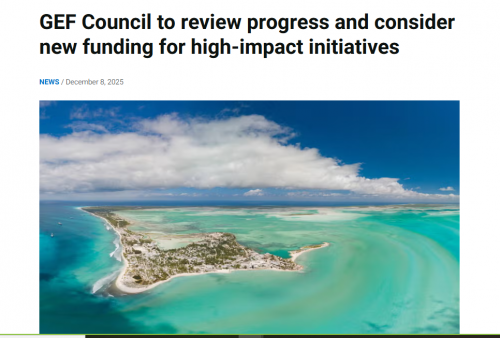
In the Pacific, proposed LDCF support to Kiribati would scale up climate-resilient land use planning, coastal zone management, and sustainable livelihoods across fragile atolls, while a Marshall Islands initiative financed through the GEF Trust Fund and SCCF will address drought, saltwater intrusion, and coastal erosion. Together, these investments are set to restore critical terrestrial and coastal ecosystems, bring thousands of hectares under improved management, and reinforce national systems that reduce long-term vulnerability in low-lying island states.
Collectively, this work program underscores the LDCF and SCCF’s leadership in delivering predictable, grant-based adaptation finance to countries facing acute climate risks. It also highlights how ecosystem restoration, inclusive governance, and community empowerment can build resilience at scale – a timely contribution as countries prepare their next generation of Nationally Determined contributions (NDCs) and transparency reports.
The GBFF Council, in its fifth meeting, will consider a $28.2 million work program including projects in Colombia, Indonesia, and Madagascar focused on advancing biodiversity conservation on land and sea by integrating ecotourism and sustainable finance, while ensuring the participation of Indigenous Peoples and local communities, including Afro-descendent communities in Colombia.
The proposed GBFF-funded projects include:
- In Colombia, the Biomanglar project would improve the management of 71,000 hectares and restore 500 hectares of key mangrove ecosystems, benefiting nearly 3,000 people —particularly women and youth from local afro descendant communities — who have safeguarded these territories for generations
- In Madagascar, the Sustainable Financing and Inclusive Management to Perpetuate Madagascar’s Locally Managed Marine Areas project would support Madagascar’s continued leadership in community-based marine conservation
- In Indonesia, the Enhancing co-benefits of conservation area management through an inclusive wildlife-based ecotourism strategy project would embed biodiversity objectives into land- and sea-use planning for five national parks and strengthen Indigenous Peoples’ and local communities’ stewardship and equitable benefit-sharing, with gender-responsive monitoring and free prior and informed consent processes reinforcing inclusive governance
GBFF Council members will also review a resource mobilization strategy to govern a predictable and ambitious capitalization of the innovative fund, with provisions to mobilize resources from non-traditional donors, including the private sector and philanthropies. Also on the agenda will be a review of a new results framework for the GBFF, to improve the ability to monitor, and report on, the fund’s contribution to the implementation of the Kunming-Montreal Global Biodiversity Framework by better aligning GBFF portfolio-level results indicators with the monitoring framework adopted by the 16th Conference of the Parties to the Convention on Biological Diversity in February 2025.