

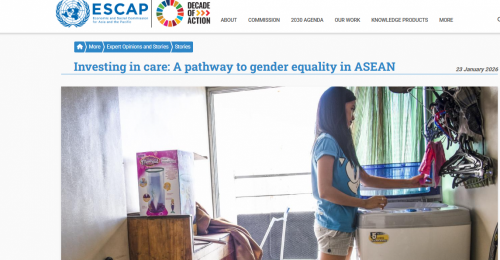
The COVID-19 pandemic reminded everyone how important care work is to daily life. When schools closed and hospitals filled up, often it was women and girls who stepped up at home. Their contributions made a big difference, yet these responsibilities often go unseen and unrewarded.
“For me, care work is the heart of humanity,” shares Leah Payud, a resilience portfolio manager at Oxfam Pilipinas. “It anchors societies, families… and keeps them running. Without someone investing time, effort and resources in essential care tasks like cooking, cleaning, childcare, nursing the elderly and sick at home, nothing else would be possible.”
Strong social norms persist in the region where care tasks are automatically handed over to women and girls. On average, women and girls across the Asia-Pacific region spend two to five times more time doing unpaid care and domestic work (UCDW) than men. In Viet Nam, women spend close to 19 hours a week on unpaid care, while men spend about 8 hours. In Malaysia and the Philippines, the gap is also clear. Women’s UCDW labour was valued at 1.6 times that of men. Despite working similar hours in paid jobs, women still take on most of the care responsibilities at home.
These care demands limit women and girls’ time, energy and ability to receive a full education or join the workforce. In 2023, fewer than half of working-age women in the Asia-Pacific region were employed, compared to nearly three-quarters of men. Many cited caregiving as the reason.
Meanwhile, paid care services remain underinvested in and undervalued. Those from marginalized or disadvantaged communities particularly bear the brunt due to low wages and relatively poor working conditions.
Experts further agree that supporting care work is good for families and the economy. A study by the International Labour Organization found that investing in care services like childcare and elder care could create up to 280 million jobs around the world by 2030. Most of these jobs would go to women. In Asia and the Pacific, recognizing unpaid care work could potentially add $3.8 trillion to the economy.
For those women in formal jobs and women entrepreneurs, the lack of care services can contribute to women dropping out of the workforce and being unable to grow and scale their businesses respectively. They face additional challenges, including the 'motherhood employment penalty,' 'motherhood wage penalty,' and 'motherhood leadership challenge.'
Post-pandemic, ASEAN leaders have been paying more attention to this issue. In 2021, ASEAN introduced the ASEAN Comprehensive Framework on the Care Economy. It encouraged countries to invest in better care services and recognize the value of both paid and unpaid care work. This Framework called for concrete steps to expand care services and support care workers, reflecting ASEAN’s broader goal of building inclusive communities.
The United Nations Economic and Social Commission for Asia and the Pacific (ESCAP) and ASEAN also have been working together to strengthen care systems across the region. Through joint research, policy dialogue and technical support, the partnership helps turn data into action. Together, ESCAP and ASEAN bring expert analysis to highlight the value of care work and support Member States to translate these insights into national policies. In 2023, ESCAP co-hosted a regional forum on care work with ASEAN. The event brought together policymakers, community leaders and experts from across the region to share ideas on what support caregivers need most, while also delving into gender-responsive and care-sensitive policies and programs.
The topic gained further momentum when Lao PDR hosted the Third ASEAN Women Leader’s Summit in 2024, backed by capacity building and knowledge support from ESCAP and various development partners. The Summit led to a new Declaration on Strengthening the Care Economy adopted by ASEAN leaders later that year, which recognizes the disproportionate presence of women in both the formal and informal care sectors, and identifies a range of gender-responsive priority actions.
“To create lasting change, we must prioritize transformative policies that recognize and redistribute the care burden equitably, without reinforcing traditional gender roles and norms. By promoting shared responsibility for caregiving among all members of society, we can pave the way for more meaningful opportunities for women to realize their full potential and empower women and girls to dream big and reach far,” shares Cai Cai, Chief of the Gender Equality and Social Inclusion Section at ESCAP.
Many ASEAN countries are already taking action. Indonesia has launched a Care Economy Roadmap and National Action Plan (2025-2045). Cambodia is close to finalizing its own national action plan. Malaysia is developing a strategy to grow its care industry. In the Philippines, care services are being strengthened through provincial and national care ordinances. Lao PDR is integrating care into both the Laos Women’s Development Plan 2026-2030 and the 10th Five-Year National Socio-Economic Development Plan. Timor-Leste is working on a new Domestic Workers Law and has set up a national Working Group on Care.
Together, these efforts reflect a shared regional commitment to making care more visible, accessible and valued.
Looking ahead, ASEAN’s next community vision presents an opportunity to make care and gender equality a stronger part of the region’s development story. Mainstreaming them across all three ASEAN community pillars will ensure ASEAN can harness all of its vast resources to accelerate progress towards achieving the global Sustainable Development Goals, in particular SDG 5 on gender equality and the empowerment of women and girls, with Target 5.4 aiming to recognize and value unpaid care and domestic work.
Care touches every part of life. Supporting care is not just about new policies. It is about recognizing the needs of real people from every background and building systems that respond to them. When we recognize and invest in care, we create more chances for women to work, for families to thrive and for communities to grow stronger.
***
The article was prepared with substantive input contributed by Channe Lindstrom Oguzhan, Social Development Division.Kavita Sukanandan