

https://rsf.org/en/2026-rsf-index-press-freedom-25-year-low?data_type=ge...
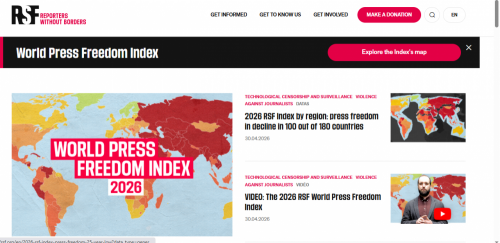
For the first time in the history of the Reporters Without Borders (RSF) World Press Freedom Index, over half of the world’s countries now fall into the “difficult” or “very serious” categories for press freedom. In 25 years, the average score of all 180 countries and territories surveyed in the Index has never been so low. Since 2001, the expansion of increasingly restrictive legal arsenals — particularly those linked to national security policies — has been steadily eroding the right to information, even in democratic countries. The Index’s legal indicator has declined the most over the past year, a clear sign that journalism is increasingly criminalised worldwide. In the Americas, the situation has evolved significantly, with the United States dropping seven places and several Latin American countries sliding deeper into a spiral of violence and repression.
Read in Ukrainian / Читати українською
“By providing a retrospective of the past 25 years, RSF isn’t just looking back — it’s looking squarely at the future with a simple question: how much longer will we tolerate the suffocation of journalism, the systematic obstruction of reporters and the continued erosion of press freedom? Although attacks on the right to information are more diverse and sophisticated, their perpetrators are now operating in plain sight. Authoritarian states, complicit or incompetent political powers, predatory economic actors and under-regulated online platforms are directly and overwhelmingly responsible for the global decline in press freedom. Given this context, inaction is a form of endorsement. It’s no longer enough just to state principles — effective measures to protect journalists are essential and must be seen as a catalyst for change. This starts with ending the criminalisation of journalism: the misuse of national security laws, SLAPPs, and the systematic obstruction of those who investigate, expose and name names. Current protection mechanisms are not strong enough; international law is being undermined and impunity is rife. We need firm guarantees and meaningful sanctions. The ball is in the court of democracies and their citizens. It is up to them to stand in the way of those who seek to silence the press. The spread of authoritarianism isn’t inevitable.
Five key takeaways from the 2026 RSF World Press Freedom Index:
-
The average score for all countries and territories worldwide has never been so low. For the first time in the Index’s 25-year history, more than half the world’s countries now fall into the “difficult” or “very serious” categories for press freedom.
-
Out of the five indicators used to assess press freedom worldwide — which determine the economic, legal, security, political and social environments for journalism — the legal indicator has seen the sharpest decline this year.
-
The United States has fallen seven places and other countries in the Americas, such as Ecuador and Peru, have plummeted in the ranking.
-
Norway holds the top spot for the tenth consecutive year, while Eritrea comes in last for the third year in a row.
-
Post-Assad Syria has seen the biggest improvement in press freedom of all the countries and territories in the 2026 Index, climbing 36 places in the ranking.
The lowest average score in a quarter of a century
Since RSF began publishing the World Press Freedom Index 25 years ago, press freedom has been gradually deteriorating. This decline is visible on the Index’s map, which turns redder every year. Journalists are still being killed and imprisoned for their work, but the tactics undermining press freedom are evolving. Journalism is being asphyxiated by hostile political discourse towards reporters, weakened by a faltering media economy, and squeezed by laws being used as weapons against the press.
For the first time in a quarter of a century:
- The overall average score of all the countries assessed has never been so low.
- In over half of the world’s countries and territories (52.2%), the state of press freedom is categorised as “difficult” or “very serious.” This category was a small minority (13.7%) in 2002.
- In 2002, 20% of the global population lived in a country where the state of press freedom was categorised as “good.” Twenty-five years later, less than 1% of the world’s population lives in a country that falls under this category.
Wars and restrictions on access to information
In some countries, such as Iraq (162nd), Sudan (161st) and Yemen (164th), recurring armed conflict is the primary reason for this decline in press freedom. Ongoing wars have had a stark impact this year, notably in Palestine (156th), where Benjamin Netanyahu’s government in Israel (which fell -4 places in the Index this year) continues its offensive. Since October 2023, more than 220 journalists have been killed in Gaza by the Israeli army, including at least 70 who were slain while carrying out their work. The same is true in Sudan (-5) and South Sudan (118, -9).
Elsewhere, the state of press freedom has hardly changed as dictatorial regimes keep it in a deadlock. This is the case in China (178th), North Korea (179th) and Eritrea (180th), where journalist Dawit Isaak has been jailed without trial for 25 years. Eastern Europe and the Middle East are the two most dangerous regions for journalists in the world, as they have been for 25 years. This is reflected in the ranking of Vladimir Putin’s Russia (172nd), which has continued its war of aggression in Ukraine and remains one of the worst countries for press freedom. Iran (177th, -1 place) also remains near the bottom of the ranking, held back by the regime’s crackdown and the US-Israeli war on its soil.
In some countries, the information space has shrunk over the past 25 years due to political changes and increasingly draconian regimes. This has notably been the case in Hong Kong (140th, -122) since Beijing tightened its control on the territory; in El Salvador (143rd), which dropped 105 places since 2014 and the start of the war on maras, or “gangs”; and in Georgia (135th), which has dropped 75 places as the crackdown on the press has intensified in recent years.
The steepest fall recorded in the 2026 Index (-37) was Niger (120th), underscoring the wider decline in press freedom in the Sahel region seen in recent years as attacks by armed groups and ruling juntas have suppressed the right to balanced information from diverse sources. In the Middle East, Saudi Arabia (-14) is paying the price for the authorities' repeated acts of violence against journalists in 2025, including the execution of Turki al-Jasser. In contrast, the fall of Bashar al-Assad’s dictatorship in December 2024 and the subsequent political transition have propelled Syria from 177th to 141st place, after years as one of the bottom ten countries in the Index.