

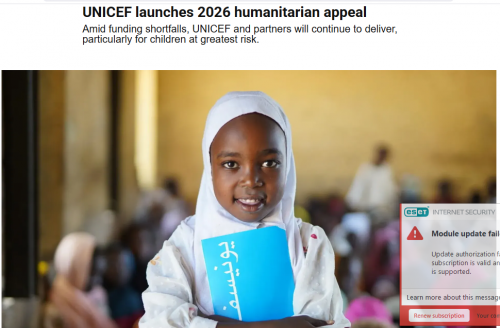
https://www.unicef.org/emergencies/launch-2026-humanitarian-appeal
Around the world, children caught in conflict, disaster, displacement and economic turmoil are facing extraordinary challenges. Their lives are being shaped by forces far beyond their control: violence, the threat of famine, intensifying climate shocks, and the widespread collapse of essential services. For millions of children, the hope of safety, learning, and a healthy future is slipping further out of reach.
Even as emergencies grow in scale and complexity, announced and anticipated funding cuts by donor governments are already limiting UNICEF’s ability to reach millions of children in dire need. We’re staying and delivering for children and families, but without urgent support we won’t be able to reach every child who requires life-saving assistance.
In 2026, UNICEF is appealing for US$7.66 billion in support of our humanitarian action for children. These funds will help us to reach 73 million children living through humanitarian crises with both immediate life-saving services, and investments for their longer-term development.
Focusing on the most vulnerable
Funding shortfalls are placing UNICEF’s life-saving programmes under immense strain. Across our operations, frontline teams are being forced into impossible decisions: prioritizing some places over others, reducing the frequency of services, or scaling back interventions that children depend on to survive.
Despite the challenges, UNICEF is working with partners to support the most vulnerable children and their families. In the first half of 2025, as part of its humanitarian response, UNICEF and partners vaccinated almost 6 million children against measles, reached more than 21 million people with safe drinking water, helped nearly 7 million children access education services, and admitted close to 3 million children for treatment of severe wasting. But the scale of children’s humanitarian needs has reached historic highs – we estimate that more than 200 million children across 133 countries and territories will need humanitarian assistance during 2026.
As we plan for 2026, UNICEF is sharpening its focus on the most critical needs of the children at greatest risk, including those living in chronically underfunded and neglected emergencies. We are strengthening preparedness and anticipatory action to reduce suffering before crises deepen. We are investing in national and local capacities, recognizing that durable, child-focused solutions depend on systems that are resilient, inclusive and adequately financed. And we are reinforcing our technical and surge capabilities so we can respond swiftly and effectively wherever needs arise.
UNICEF is also helping to reimagine how the global humanitarian system operates. This includes supporting governments to lead, engaging regional actors, and bridging humanitarian and development efforts to reduce long-term vulnerability.
But predictable, flexible and multi-year funding is essential for UNICEF’s work. Quality financing is not only more efficient – it saves lives, strengthens systems, and allows us to reach children in places that are too often neglected.